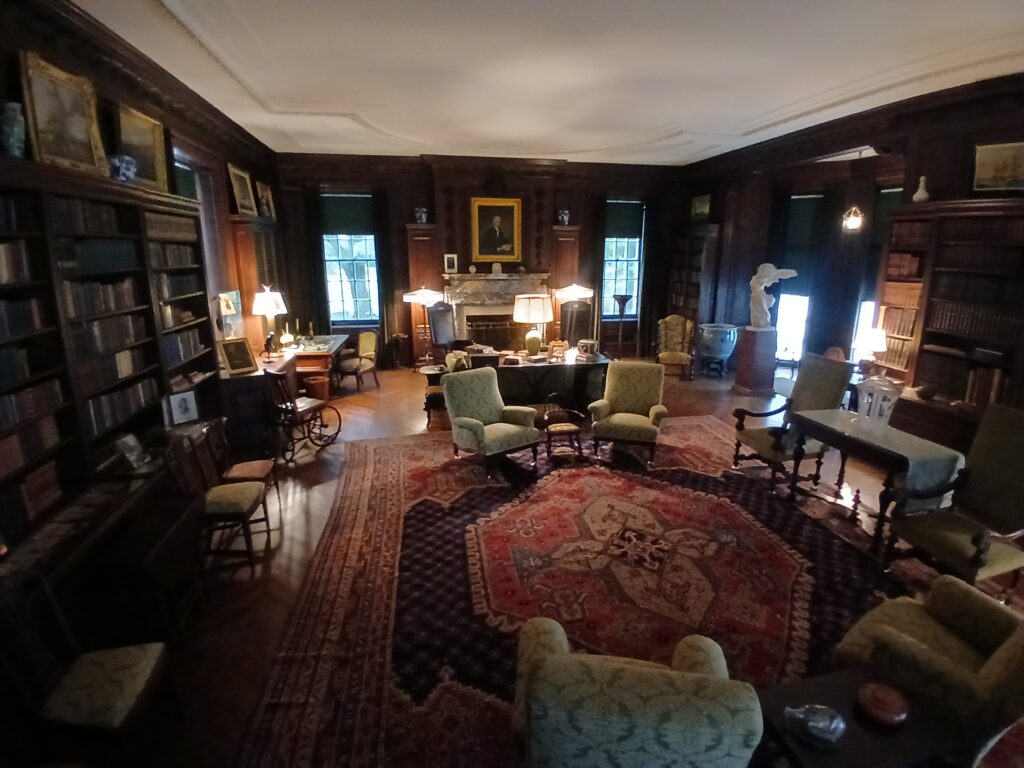
You don’t have to be a history buff to appreciate FDR’s house and library with kids in Hyde Park, New York. As someone who did not live through that era, I found it astounding how many advancements in our social fabric came from FDR’s four terms in presidential office (yes, 12 years, four terms – the longest-serving president).


A brief history about FDR
The Springwood house and acreage was in FDR’s family prior to him entering the world. His parents bought the 110 acres of land and built a house there, smaller than what you see now, and he was raised there. With private tutors and eventually boarding school, he spent a lot of time on the property learning about trees. His father was a “gentleman farmer” and FDR himself apparently cultivated about 500,000 trees on the property during this time there.

While he did not need to work (the family was quite wealthy), he became a practicing lawyer, and eventually a politician. He was a New York state senator, and then the assistant secretary of the Navy.

At some point he married a distant cousin, Eleanor Roosevelt. They initially lived in the Springwood home with his mother, Sara. He renovated and expanded the house. He made the portico look like the White House, thinking that at some point he might live there.
FDR contracted polio in 1921 at age 39, going to bed one night not feeling well, and waking up unable to move. He eventually regained arm movement, but not leg movement. He became involved with the March of Dimes, the organization that later funded an effective vaccine.

At the time, physically disabled people were seen as not mentally capable. His mother told him to retire, but Eleanor thought he could continue his political career and she encouraged him to do so. Wheelchairs were not common for everyday use. They were called invalid chairs. The ADA was not implemented until 1990. During FDR’s time as president, they’d have to create ad hoc ramps for him. He made his own wheelchairs using kitchen chairs and bicycle tires. He also used 14-pound steel and leather braces to keep his legs in place so he could use crutches to walk shorter distances.

His bedroom was on the second floor and he had a separate bedroom as he had to be turned several times a night due to his polio. In his room you’ll see the phone next to the bed (photo below), which was the first direct line in the U.S., and it went to the White House.

You’ll also see a manual elevator with a rope pull system, which was installed in 1915 to bring luggage upstairs. After the polio diagnosis, he used to pull himself up to the second floor with his upper body strength, sometimes with kids in his lap.

Some fun facts: The library in the house could hold 3,500 books but he owned 22,000. He loved murder mysteries. At one point, he also had the largest collection of naval prints in the U.S. He also had a large collection of British political cartoons, some of which you’ll see in the foyer of the house.

He worked from Springwood sometimes and had other politicians visit there. Churchill came four times during WWII. The New Deal was fashioned here, as was the Manhattan Project and the Japanese internment orders.
You’ll see the dining room below, and a kids’ table in the back. He had 6 kids, with 5 surviving infanthood.

We also visited the FDR library on the property. This was the first presidential library.
There are movies and interactive exhibits to learn more about how FDR won the Democratic Party nomination for the presidency in 1932. He was the first candidate to ever accept a nomination in person. This was during the Depression and his call for government action to intervene in the economy helped boost his win (a New Deal).

During his first administration, he got banking bills passed to stabilize the banking system (starting the FDIC), provided work through the Works Projects Administration (WPA), and the Social Security Act. His administrations got the Fair Labor Standards Act passed, with labor advancements. He spoke directly to the people through his famous fireside chats.
The two-story library includes a wealth of interesting displays that go chronologically. It is too much to take in during one visit. Plenty of it could be interesting to kids (maybe not the youngest ones). They do have some fun things for kids like a car on display and his White House desk (they can try to figure out what is on it).

FDR died of a stroke at age 63, during his fourth term. He is buried on site and you can see his grave.
The museum/library also shares about Eleanor’s role. She had a stronger hand as the first lady than many other first ladies, focusing heavily on women’s issues and civil rights. After his death, Eleanor lived nearby at Val-Kill. We planned to visit there too, but ran out of time.
If you visit FDR’s house and library with kids
There are multiple sites to visit at the FDR property (plus Val-Kill). They have a café in the visitor center, where you’ll park.
They do not accept reservations for the FDR home tour, which takes about an hour including getting over there from the visitor’s center.
The park service recommends 1-3 hours for the library/museum, which seems accurate to me. We were there about 2 hours, and it was not enough for us.
There is also a home garden, which we did not visit. That would take 15-30 minutes, per the NPS. We also did not visit the Walled Garden at Bellefield, on the property. That is a 15-45 minute visit.
You can hike the Farm Lane Trail between the Roosevelt house and Val-Kill, and some other local sites. That is a 1-2 hour excursion and it is part of a historic road network.
Have you visited FDR’s house and library with kids? What tips do you have?